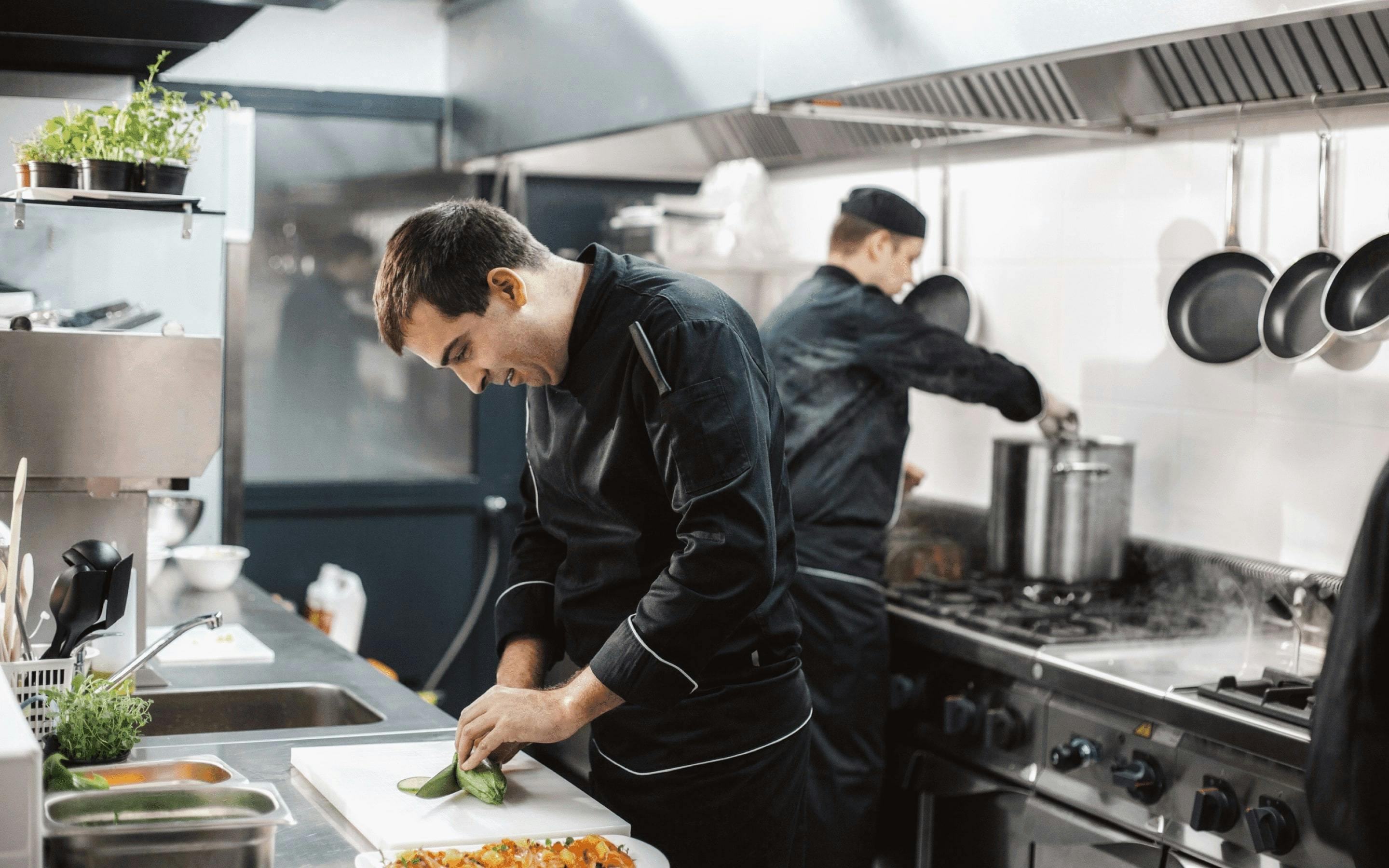
Did you know that the layout of your commercial kitchen has a direct impact on how efficiently your team operates? The way your space is arranged affects everything, from food safety and hygiene to how smoothly your staff can move and work, particularly in a compact setup like a ghost kitchen.
When planning your kitchen, think through the full food preparation cycle: ingredients come in, get prepped, cooked, and packaged, then everything gets cleaned and stored. A well-designed kitchen supports each of these stages without bottlenecks. The core zones to plan around are:
- Storage and stock room
- Food preparation area
- Cooking area
- Service and packaging station
- Dishwashing area
With the right layout in place, you can maximise every square metre, improve team performance, and maintain a safe, efficient working environment. But which layout is right for your operation? Let us walk you through the most common commercial kitchen designs.
Commercial Kitchen Layout Options
There is no single perfect layout, as it depends on how you use your kitchen, its size, and the placement of your fixtures and equipment. Here are the five most widely used commercial kitchen designs today:
- Assembly Line
- Zone-Style
- Galley
- Island
- Open Kitchen
1. Assembly Line Layout
The assembly line layout is ideal for busy delivery-only kitchens that consistently produce high volumes of food. It creates a clear separation between storage and cleaning areas on one side, and food preparation, cooking, and packaging on the other. Food preparation begins at the start of the line, with the finished dish emerging at the far end ready for dispatch.
This layout follows a linear workflow: ingredients are prepped and assembled first, the line flows into the cooking area, and then finishes at a plating or packaging station. Washing and storage sit behind the line so they do not disrupt the chefs working through orders.
Advantages:
- Each team member focuses on individual tasks without crossing into other stations
- Well-suited to limited menus and high order volumes
- Supports fast, consistent meal production
Disadvantages:
- Less flexibility for menu updates due to the fixed, linear workflow
- The focus on speed can leave little room for creativity or dish innovation
2. Zone-Style Layout
The zone-style layout divides the kitchen into dedicated sections based on the type of dish being prepared. Each station is separated from the others, typically by equipment type or preparation requirements. This suits kitchens that run a broader menu with multiple cuisines.
Dishwashing and storage areas are usually positioned closest to the entrance, while the service and packaging station sits closest to the exit.
Advantages:
- Ideal for large, multi-functional kitchens
- Allows staff to focus on their area of expertise
- Makes it easier to prepare a wide variety of dishes from a larger menu
Disadvantages:
- More expensive to build out, as each zone requires different equipment and infrastructure
- Setup costs are too significant to justify for a small or focused menu
3. Galley Layout
The galley layout is the go-to option when space is limited, making it a strong fit for ghost kitchen rental setups, which tend to be more compact than traditional commercial kitchens. All stations and equipment are arranged along the walls, leaving the centre of the space clear. The name comes from the original use of this design in boat galleys, where space is at an absolute premium.
Advantages:
- Maximises square footage, much like in boats or food trucks
- Well-suited to ghost kitchens and smaller commercial kitchen spaces
Disadvantages:
- Better suited to a smaller, more focused menu
- Opposing workstations can become cramped, slowing down food preparation and reducing productivity
4. Island Layout
In an island layout, all cooking equipment is centralised in a single island unit in the middle of the kitchen. The surrounding perimeter is used for food preparation, storage, and dishwashing, giving the head chef a clear focal point to oversee all activity.
For ghost kitchens where order accuracy matters, smart kitchen software paired with an island layout offers strong oversight advantages. This makes it easier to manage quality across multiple orders at once.
Advantages:
- The island acts as a command centre, putting the head chef in full view of all kitchen activity
- Easier to monitor quality and consistency across orders
Disadvantages:
- Requires strong communication between stations without a fixed linear workflow
- Takes up significant floor space and is not suitable for smaller kitchens
5. Open Kitchen Layout
Similar to the island layout, the open kitchen design places cooking at the centre of the operation. For delivery and production kitchens, it is valued for transparency and ease of supervision. Nothing is hidden, and team leads can monitor every station at a glance.
The setup is typically circular or wraparound to allow easy movement, with storage and dishwashing pushed to the back. Because open kitchen layouts vary by space, equipment, and cooking style, there is no single standard floor plan.
Advantages:
- Full visibility across all stations encourages accountability and keeps standards high
- Easy movement and open space support a smooth operational flow
Disadvantages:
- Noise, smells, and activity can affect the wider environment if adjacent to other spaces
- Increases the risk of cross-contamination between food preparation areas
Ready to Set Up Your Ghost Kitchen?
Choosing the right layout is one of the most important decisions you will make when setting up your kitchen, and you want to get it right from the start. The layout you choose will shape how your team works, how efficiently orders go out, and how comfortably your operation can scale.
If you are looking for a kitchen for rent in Riyadh, Dubai, or Kuwait City, KitchenPark makes it straightforward. Our kitchen units come equipped with a three-compartment sink and a commercial extractor hood as standard, and our team is on hand to help you find the right setup for your menu and your goals. Get in touch today to book a tour.